Friday, 27 March 2015

FMP Week 2

Still using the components from the sewing machine, I considered the screws again.

I mean to say, if I am taking the screws from all of these objects, reducing them to almost identical multiples, how can you change anything else? I will end up with piles and piles of screws, and nobody will be able to tell the difference.

This is the point where I need to ask if there is a difference at all? I began this sort of work by trying to remove some of the most important things (structurally) and end up removing the function, but with this I've taken away the most defining characteristics. Are the screws entirely meaningless? I think that because I've been thinking so hard, and then attempting to avoid thinking entirely, I've lost the plot.


So after arranging these screws, it's getting dull - it's the same thing I've been doing, and I enjoy working with the materials but no matter what I do I just don't feel like I'm making any progress. Perhaps its because this week I haven't asked my peers any specific questions concerning my work, especially important to me because the structure of my project does rely on exactly how people perceive them.

And how will people perceive them here? As photos. Because I've taken the pieces and divorced them from all semblance of meaning and purpose, are photos not just as meaningful? I will have to see about it with my next object.

Friday, 20 March 2015

FMP Week 1

The first week of my final major project saw me following my proposed timetable to deconstruct my first object. I found not only the screws that I had anticipated (it being an item of household machinery that was not at all digital) but a variety of interesting artefacts in the interior.

Starting with these. I displayed them without thought - not randomly, but in a way that was aesthetically pleasing to me on a very basic level.

After looking at it I decided that this was the way they should be displayed.

Was this a trivial decision? Yes. Yes it was trivial but I've now decided that this precise order and relative positioning is the correct way to display these objects.

If I say that, am I creating a new piece, in a sense? That's what I have made it - a piece of art that has a right and wrong composition. Whilst this could be evidence of spending far too long with a screwdriver in hand, I can't say that I dislike the line of thinking I have begun to follow.


These four objects I have also but be displayed with each other in mind.  I think they could be displayed far away from each other, however the pairs must be level. This is because the two that are shaped in a way reminiscent of bullets are perfectly identical, and the other two are not.

I think that drawing attention to this fact can be meaningful with the understanding that an identical pair and a non-identical pair are being associated. What can that communicate?

Potentially the idea that they can be equal in value. I am very aware of the fact that I am projecting this meaning onto the objects, and that they were not shared when I showed the objects to my peers - the display was compared more to that of some kind of typeface, as I had spread these particular pieces further apart on the table.


These pieces I placed in this specific order to show a sense of progression: smooth; harsher; sharper; then with fewer, straighter edges.


These pieces were the only ones that gave away what the machine was - anybody who is familiar with the object can recognise one specific piece and know it. The objects above were - like all of these objects - placed deliberately. These are in fact placed in order of height of where they sat in the machine.

What I actually did in the session of peer review was ask a series of questions to gain an insight to the  opinions of the 'cold' viewer.

When asked what words they instantly associated the art with, they responded 'metal', 'steel', 'urban materials', 'language', 'assembly', and so forth. It was interesting to be taken back to the first impressions as someone who has spent weeks roughly navigating the subject already with other projects. That alone has made me consider the fact that this work requires thought, it requires time to think about it.

When asked for a second, more developed work, I received answers such as 'work', 'broken', 'organisation' and 'reading'. I realised that the second words offered were no longer the very basic descriptions of the objects, rather a step closer to the viewer's relationship with the objects.

Only one person correctly guessed what the item was at first, and it was unexpected that when no objects were recognised the sources of the parts were in total doubt. Were they from the same or a different object? Did I buy them? Did I really take apart an object? Nobody would hazard a guess. Then, when I revealed that yes, that particular piece was the foot of a sewing machine, the assumption was instantly that all the pieces were from the same machine, that I had taken apart myself.

Lastly, when I asked "Does that matter?" the conclusive answer was "No."


Friday, 13 March 2015

Final Major Project Proposal

Throughout this course I have been able to test out new media and ways of working, and have thoroughly enjoyed the ability to explore the subject of Fine Art with a greater freedom. Since the beginning of term I have been steadily progressing away from structured projects and into self-driven study, work that has led me to consider the deconstruction of objects, and the act of removing an object from it’s only function.

I have also been considering how presentation affects perception, be it in photographs, object suspension, the varying heights of plinths or displayed simply on the floor – one piece can be interpreted in many ways if presented in a different manner, especially when the name of it can hold such power over the preconceptions of the viewer.

The main objectives of the project are to gain a better understanding of how reducing an object to components, displaying these parts, and changing the way in which we refer to them might affect our perception and understanding of the art. 

The concept of my project centres heavily around our use of objects, and our perceptions of their space, density, form and function. My initial starting point will be the deconstruction of various objects and appliances, and from there the direction of the project will depend entirely of what I find.

Possible items include an old sewing machine, a lawn mower and a DVD player. Two purely mechanical tools and one that will contain various parts of circuitry; hopefully to provide a large variety of screws and components. After deconstructing these appliances I will explore the possibilities of simplifying them, asking how much can be taken away before the item is no longer itself, at what point it becomes impossible to argue that it still has purpose.

I also hope to use this project to examine the nature of our preconceived ideas when viewing the deconstructions that I create – just how much of an impact does the title have? Is it necessary in order for the pieces to be understood at all, or will there be some other meaning attributed to the pieces?

I intend to dismantle a different machine every two weeks, and structure my analysis in two parts – the deconstruction and then the perception. This will allow me to approach each machine in a way similar enough to form a basis from which to compare the results – resting on the assumption that the contents of the objects will provide individual and unique results.

Lastly, as people’s perceptions are such a key theme of my project, I will frequently discuss and review the pieces I create with my peers. This will help me gain a wider understanding of the different interpretations that any one object may inspire, and therefore a greater understanding of the pieces themselves.

Thursday, 5 March 2015

The 2D

Enthused with the wonder of the solar system (a very exciting thing) I kept thinking about gravity, and how concisely the previous line of experimentation seemed to have expressed the concept to me.

The work I then produced was a bit of a tangent. Having previously rejected the notion of including additional materials I went and brought in a fine liner. The image below is an A4 drawing using black fine liner straight into my sketchbook, and it was an attempt to create a textured density - using dots and scratches and scribbles I tried to make a 2D representation of gravity.


Whether or not I succeeded in that I am still not entirely sure - some people think it's obviously expressing a shift in density and instantly think of planets and stars, and some people have exclaimed "it's like a jam donut!", and I don't think they're wrong either.

I then was not content to move on - not least because I had run out of machines to take apart. I photocopied the piece several times, enlarging it and cutting it up and re-arranging even the image itself. 


Above is my favourite example - I had already experimented with ribboning and changing the display of photographs before, and this image greatly interests me because I have not changed the density nor mass of the image, the entire thing is there, and yet we see twice as much and only half at the same time.

We fill in the blanks to find the whole thing, and end up with two.

Whether or not I choose to make any more drawings along this line of thinking, I am not sure. I really enjoyed making it (for five hours, it occupied a fair train journey) and it was an interesting tangent to explore, however I feel that it it precisely that - tangental - to a lot of the work I was creating before.

Nevertheless, if I naturally respond to future forms I create in the future with this sort of drawing, I won't stop it from happening.


Thursday, 19 February 2015

Gravity

As a result of 'reducing' down I have been considering more arrangements and forms.

Firstly, I arranged the screws in a rough sphere, the largest in the middle. This gives the shape the illusion of density, and I feel is expressive of a gravitational pull - it makes me think of the early stages of the formation of a planet, wherein larger masses converge, and as they grow they pull in smaller pieces.


I then neatened the edge, and pulled the larger pieces away from the centre. Whether the simile of the formation of a planet could be extended here is questionable - I feel that it has taken a step away from the larger scale.


However, with the addition of this next picture (showing that I have decreased the circumference of the outer circle, pulling the larger screws once more into the centre) I have created a sense of narrative - when displaying the pictures in sequence it becomes clear that there is some kind of process occurring.


And the final piece in the narrative brings my mind back once more to the formation of a planet, however now it is the final stage - wherein the gravitational pull has formed a roughly spherical shape enveloping the central force, larger, simpler components towards the middle, whilst the outer layers are more complex.

What is interesting about this comparison to me is how trivial the arrangement truly is - both of the screws and of the creation of planets, and how one is larger to the extent that the human mind cannot entirely comprehend it. Also I greatly love how neat it seems - the screws from a typewriter arranged in a very different way, still managing to help create a story.


I find that when I have the concept of planets and solar systems so clear in my mind when observing the screws, I stop seeing them as screws and they become symbols. I think that it is easy, when looking at photographs, to forget about scale. In order to bring reality closer, I arranged the screws around my outstretched hand.

I think that having this image afterwards does help to bring the real world closer, and then at once I realise that I don't want the real world to be closer. The symbol of the hand is yet another reminder to me that this is a pile of screws on a table, its something physical and trivial that I have done, and it's right there - temporary and practically meaningless. Whilst it may turn the story towards me, towards the human inventor or worker, I find the formation of the universe to be such a hugely magical idea that anything following seems dull.

Perhaps, if we make this the final piece of the narrative, it could be taken as a statement of the human impact on the planet - there is no sphere left, as I used the screws to make the shape. With enough human meddling, will we destroy the planet? I think it's a fair point, if a point made incredibly frequently to the extent that it's cliché.

Of course, this all rests on the assumption that when faced with the original picture, everybody thinks of the science behind the birth of planets, which seems fragile.


Thursday, 5 February 2015

Reduction

Following the line of development, I've decided that 'Reduction' is a suitable title for this series of work that I've been producing.

Because, logically, 'reducing' the form of these objects is exactly what I am doing. From the moment in the Catalysts project when I decided to deconstruct the CD player, I was reducing it's form to simply the screws. Whether or not this action has any particular meaning can still be debated - I prescribed no meaning to it besides 'destruction' when I started, and only later did I contemplate what it could have signified.

After developing a pattern of behaviours (find item, unscrew item, glue screws together, bin mess, rinse, repeat...) I felt that I was making no progress. Whilst I had very much enjoyed reducing these items, I've simply ended up with a collection of reduced forms, and how can I change that? How can I possibly continue without getting bored? Once you establish routine, you normalise the forms and from that point on it becomes repetitive and dull.

In an attempt to explore the other possible forms, I've totally avoided the super glue. Below are the screws found in a broken typewriter I liberated from my local dump. 

I laid them out neatly on an A4 sheet - it occurred to me later that this was fairly ironic, as a white A4 sheet of paper may be exactly what we put in the typewriter, so the presentation forms what is almost a parody of the destroyed function. 


In addition to the screws, an interesting metal form was found as part of the leverage to pull the letters to print the page. These little hooks were a vital part of the structural tension of the typewriter. After I sorted them out by their specific shape and curvature, I photographed them on an A4 page of my sketchbook. I decided to glue them in, in exactly this form, as I found it aesthetically pleasing.


To progress with the screws, I researched into forms of kinetic sculpture - the antithesis of the static sculptures I had created. I also had wanted to try fixing the screws together using some other medium, so I tied them together with string. Unfortunately within moments the strands became tangled, and the string was too fragile to pull it all apart. 

To recover this, I did nothing.


Instead, I simply experimented with the mess that I had. If I stretch it out it looks like fruit on branches. If I shove it all in a bunch in the middle then it looks more dense, as it occupies space on the page in a shape that we can understand more easily.

By changing the shape, I can change the perception of the mass present.


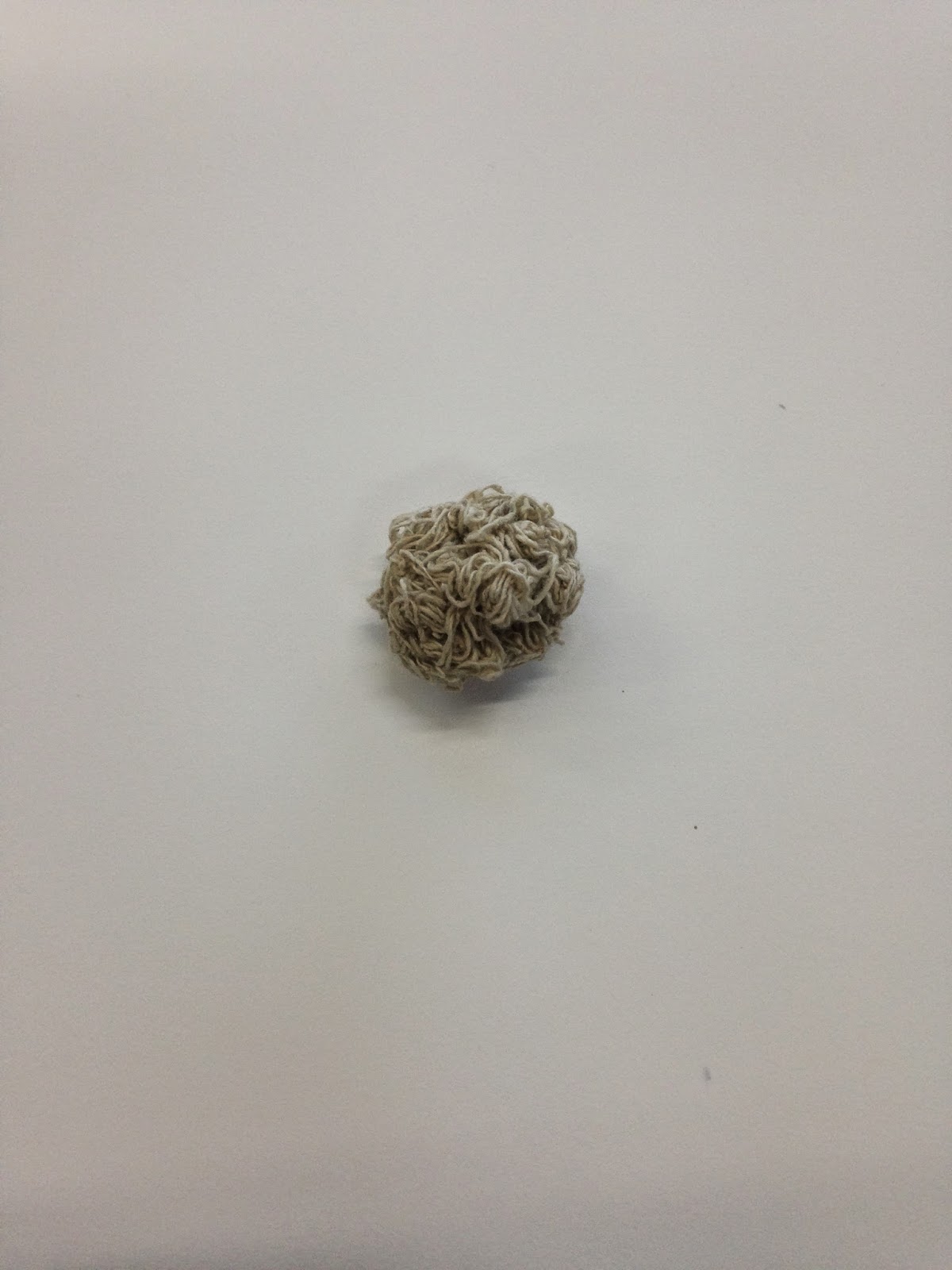
The last image shown above is the string left over after removing the screws. I'm not sure if I like it, mostly because it was born out of a deep frustration and untying all the knots hurt my fingers. Also quite frankly the string bundled up looks strangely reminiscent of noodles, and any significance in the transformation of the space/mass is lost in the viewer thinking of noodles.

So I feel like I've reached a dead end here, unless I want to bring new materials into the mix. 

With the screws now separate, I decided to fix them together with a piece of wire. Here they are in the chain created.


This now appears as some awful crack through the white image. It's also a much more awkward shape to display, and creates a larger volume of space around it in the image.

I don't know what line of thinking I wish to develop - whether I consider new materials and continue reducing (but by introducing something 'new' this seems to have shot itself in the foot already) or start reducing another object in hope that I will discover an idea that I believe is suitable for the project.

Saturday, 17 January 2015

Follow-up

Instead of following the project work, after the Christmas holidays I decided to return to the more conceptual work I'd been doing with the screws and once-weres. I continued to take electronic appliances apart - items including headphones, a walkman, and then later a washing machine and a computer. 


I found that out of all the ways of displaying the small sculptures, this fashion creates a sense of blank space around them, which draws attention to how little space they actually occupy. This is especially notable when the piece has a title such as 'Washing Machine'.

Beyond the therapeutic nature of disassembling formerly functional, the act of taking something as cumbersome as a washing machine was an opportunity to glimpse into an unknown part of our daily life - millions of people own these things, and hardly any of them will have seen the inside of one.

It is with this in mind that I now present the final sculptures, tiny and void of the density with which they used to occupy space.

I would say that displaying the sculptures in one row is a more effective way of drawing attention to their lack of body, and when they are spread out and given a larger background the effect can be increased tenfold.

How much I wish to explore this remains undecided, however I do wish to continue experimenting with displaying the screws in different manners, to investigate how to manipulate the perception of the space surrounding them.